Apr 8, 2011

Fish , Mix Media with Paper Plate


This was done in 2 session using paper plates. 
The first part was a COLOR BLUE collage, using torn blue paper, tissue paper, yarn etc...

The secend session: the Gold fish, embossed aluminum sheet that was precut in the shape of the fish, then designing the frame with paint and color sand.
We stapled the 2 plates together and  stringed the fish in the frame.

Mar 28, 2011

Passover Collage

A Passover Haggadah is a book outlining the order of the Seder. 
Looking at the Haggadah you can see decorative borders, illustrated text boxes and decorative letters to begin paragraphs.


Our Passover collage, using photocopy page of the Haggadah, embossed aluninium sheets and silver paint.

Mar 8, 2011

Contrast in Nature


Walking by this tree today, I wondered at the contrasting shapes in nature.
To protect the fruit of the tree, the treet growes hundreds of torns some the size of 3 inches.
In contrast to the fruit, which starts as a green oval shape the size of a pear, 
Then when opening  there is a floppy white cotton looking ball inside.
That  expands to to form  a shape around 3 times the size of the fruit in awonderful  and perfect pompom ball shape, ( as in  photo above).
The cotton shape slowly loses its shape, break apart and falls to the ground.
Later on the fruit will bloom  to form  beautiful white flower. 

Feb 25, 2011

Personal Map Collage

Inspired by Orly Avineri Blog, a beautiful one-artist journal I go back to the first post "personal map" collage.


Orly Avineri  write in her blog 
"I am a creator of intimate maps, just like you, we are all creators of boundless paths, treading continually, laying down tracks for moving forward."


Feb 21, 2011

Why Art? 10 Lessons Art Teach

Taken from   Nickels Intermediate Art page  Why Art?
Elliott Eisner, a Professor of Education at Stanford University has identified 10 lessons which are clarified through the study of Art in schools.


Ten Lessons the Arts Teach
• The arts teach children to make good judgments about qualitative relationships. Unlike much of the curriculum in which correct answers and rules prevail, in the arts, it is judgment rather than rules that prevail.

• The arts teach children that problems can have more than one solution and that questions can have more than one answer.

• The arts celebrate multiple perspectives. One of their large lessons is that there are many ways to see and interpret the world.

• The arts teach children that in complex forms of problem-solving purposes are seldom fixed, but change with circumstance and opportunity. Learning in the arts requires the ability and willingness to surrender to the unanticipated possibilities of the work as it unfolds.
• The arts make vivid the fact that words do not, in their literal form or number, exhaust what we can know. The limits of our language do not define the limits of our cognition.

• The arts teach students that small differences can have large effects. The arts traffic in subtleties.

• The arts teach students to think through and within a material. All art forms employ some means through which images become real.
• The arts help children learn to say what cannot be said. When children are invited to disclose what a work of art helps them feel, they must reach into their poetic capacities to find the words that will do the job.
• The arts enable us to have experience we can have from no other source and through such experience to discover the range and variety of what we are capable of feeling.

• The arts' position in the school curriculum symbolizes to the young what adults believe is important.

Elliott Eisner, in Beyond Creating: The Place for Art in America's Schools. Getty Center for Education in the Arts. 1985 p. 69.

Feb 7, 2011

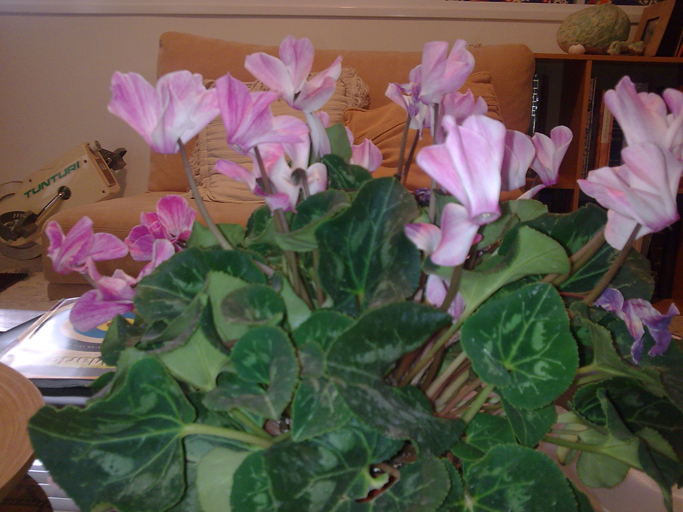
Winter Flower, Cyclaman plant

Another sign of winter is the cyclaman plant growing between the rocks, last year I all so posted a project using a heart shape stancil.
Using old notebook covers that I saved to use as a base for a future art project I cut heart shape stancils.
With that they drew with oil pastels the leaves of the cyclaman plant my favored winter flower. And waterdown guache was used for background.
The flowers was made on a trasparence sheet; using plasticine on the line drawing; in the same technique as the winter snail.

Jan 21, 2011

Art and Life

I love following Orly in her Art Journal Blog, as always her words are inspiring as well as the beautiful artwork.
"The process of making art is the same of making life. It’s one of constantly making choices of what goes in, and what goes out, what to add and what to omit, what to pick, and what to leave out, what to discard and what to save. It’s the culmination of our choices that makes our art and life what they are…beautiful."